Cover Story, September 2026: The other odyssey: Antoni Hervàs’ ‘Cabeiria’ 10 years on
Tue, Sep 1 2026 
September 2026 cover story on www.lttds.org
NEW
NEW MONTH
NEW MONTHLY COVER
NEW MONTHLY COVER STORYThe September 2026 monthly Cover Story, “The other odyssey: Antoni Hervàs’ ‘Cabeiria’ 10 years on”, is up on our homepage: www.lttds.org
“This month marks the 10th anniversary of one of our most rewarding curatorial experiences: Antoni Hervàs’ ‘The Mystery of Cabeiria’, presented in 2016 at La Capella, Barcelona, as part of Barcelona Producció, the annual open call for artistic projects.” → Continue reading (after September, this story will be archived here).
Cover Stories are published monthly on Latitudes’ homepage, showcasing past, present, or upcoming projects, research, texts, artworks, exhibitions, films, objects, or field trips related to our curatorial work and activities.
→ RELATED CONTENTS:
- Archive of Monthly Cover Stories
- Cover Story, July-August 2026: Topacio's Afterglow, 9 July 2026
- Cover Story, June 2026: Mónica Mays: Pulgar, 2 June 2026
- Cover Story, May 2026: Deep Blue: Hemauer/Keller & Kapwani Kiwanga, 30 April 2026
- Cover Story, April 2026: When Down Becomes a Condition, 1 April 2026
- Cover Story, March 2026: I Still Fear No Evil, 2 March 2026
- Cover Story, February 2026: Museum Myths, 2 February 2026
- Cover Story, January 2026: Waves Lost at Sea, 2 January 2026
- Cover Story, December 2025: Mentorship and Movement, 30 Nov 2025
- Cover Story, November 2025: Lido Lagoon, 3 Nov 2025
- Cover Story, October 2025: Stockholm, September, Sessions, Studios, Samuelson, 1 Oct 2025
- Cover Story, September 2025: Krasiński at 130 centimetres, 1 Sep 2025

Latitudes’ "out of office": wrap up of the 2020-21 season
Mon, Aug 2 2021
‘Keep the faith’ banner hanging at the entrance of La Escocesa studio facilities. All photos by Latitudes (unless otherwise noted in the photo caption).
This end of the season post is the thirteenth of the series – see 2008-9, 2009-10, 2010-11, 2011-12, 2012–13, 2013–14, 2014–15, 2015–16, 2016–17, 2017–18, 2018–19, 2019–20 posts. Unlike past years, there was no clear beginning to the 2020–21 season. As many of us experienced, the pandemic put our work and life plans on hold, at worst cancelled. August is usually a strange month for freelancers (at least in our sector and in these southern latitudes), as nothing much happens work-wise. Yet it can be a blessing if one has other activities to push through, such as writing or research, as hardly any work e-mails come into the inbox – even e-flux’s periodicity is reduced!— but it’s also a fearful period for income.
We have been lucky to be able to work throughout this year on two group exhibitions: ‘Things Things Say’ at the Centre d'Art Contemporani de Barcelona Fabra i Coats (October 2020–January 2021) and the forthcoming ‘Notes for an Eye Fire’ at Museu d'Art Contemporani de Barcelona (MACBA) opening October 21, 2021, which has not only kept us afloat but also made it possible for us to work within our immediate context in times when travel has not been possible or even desired. Here's our 2020-21 from behind the scenes:
5 August 2020: Max’s (Contributing editor, frieze magazine since 2015) review of Daniel G. Andújar show at La Virreina coincided with the new launch of frieze redesigned website.

13 August 2020: Eulàlia Rovira sends us a view of the improvised recording studio she managed to set up at home in order to become the voice of the exhibition ‘Things Things Say’. We are deeply thankful to her for her flexibility and endurance in recording our texts in three languages deep in the summer heat and in the small hours of the night to avoid neighbourhood noises. #ThingsThingsSay


31 August 2020: Between June and December 2020, Max was Editor of Season 01 of st_age and TBA21’s social media. Pictured a "new normality" Zoom with the TBA21 team across Madrid and Vienna offices, plus team members in Prague, London, Ibiza, Barcelona, etc.

7 September 2020: After months of communicating by phone and email with Pere Fernàndez Bori, president of the Friends of Fabra i Coats, we were finally able to meet IRL as he showed us around the association offices and archives. We are very thankful to Pere and the Friends of Fabra i Coats for their time and willingness to lend us materials for the exhibition at the Fabra i Coats: Contemporary Art Center of Barcelona.


7 September 2020: First meeting with Rasmus Nilausen in the museum galleries. #PanoramaMACBA


15 September 2020: Conversation between Lola Lasurt and Rosa Maria Subirana Torrent, moderated by Ángel Calvo Ulloa, as part of Lasurt’s solo exhibition ‘Children's Games’ at La Capella. The conversation focused on Subirana’s meticulous inventory of the holdings of the first collections of contemporary art donated to the city as coordinator of Miró Year, which included the organisation of Joan Miró’s 1968 retrospective on the grounds of the former Hospital de la Santa Creu, the current venue of La Capella. Video here (Catalan and Spanish). Lasurt’s project was tutored by Latitudes as part of the 2020–21 season of Barcelona Producció.

23 September 2020: Self-timer selfie during our first studio visit with Marria Pratts in L’Hospitalet. #PanoramaMACBA

24 September 2020: As a culmination of Lasurt’s solo exhibition ‘Children’s Games’ at La Capella, and as part of Jordi Ferreiro’s mediation programme Exedra εξέδρα, Lasurt offered to paint a “transitional object” and to display it in a balcony of a neighbour of the Ciutat Vella district. In this case, the transitional object is a train from the cartoon series ‘A Little Engine That Could’ (1991) that Meritxell used to watch on VHS with her grandparents as a child.


Photos: Eva Carasol.
28 September 2020: New episode of Incidents (of Travel) from Cabo Rojo, Puerto Rico went live! In the latest ‘Incidents (of Travel)’ dispatch from Cabo Rojo, in the southwestern corner of Puerto Rico, and on week 23 of lockdown, Sofía Gallisá and Marina Reyes begin a day together by driving to the Cabo Rojo Salt Flats where Sofía researched her film ‘Assimilate & Destroy I’ (2018).
Incidents (of Travel) is an online project produced by KADIST that explores different corners of the world through chartered day-long travel itineraries as a form of artistic encounters and an extended conversation between a curator and an artist. #IncidentsofTravel

29 September 2020: First video call with El Palomar (Mariokissme and R. Marcos Mota). #PanoramaMACBA

1 October 2020: Beginning of installation of ‘Things Things Say’. Arrival of the works by Stuart Whipps, Sarah Ortmeyer and Annette Kelm at Fabra i Coats. Arterri team transported the pieces from Berlin, Dunkerque and Birmingham to the art centre and were assisted by JBM Muntatges i produccions crew on-site to accommodate the works in the exhibition space.


A socially distant download of Stuart Whipps's car.


JBM Muntatges i produccions crew constructing walls.
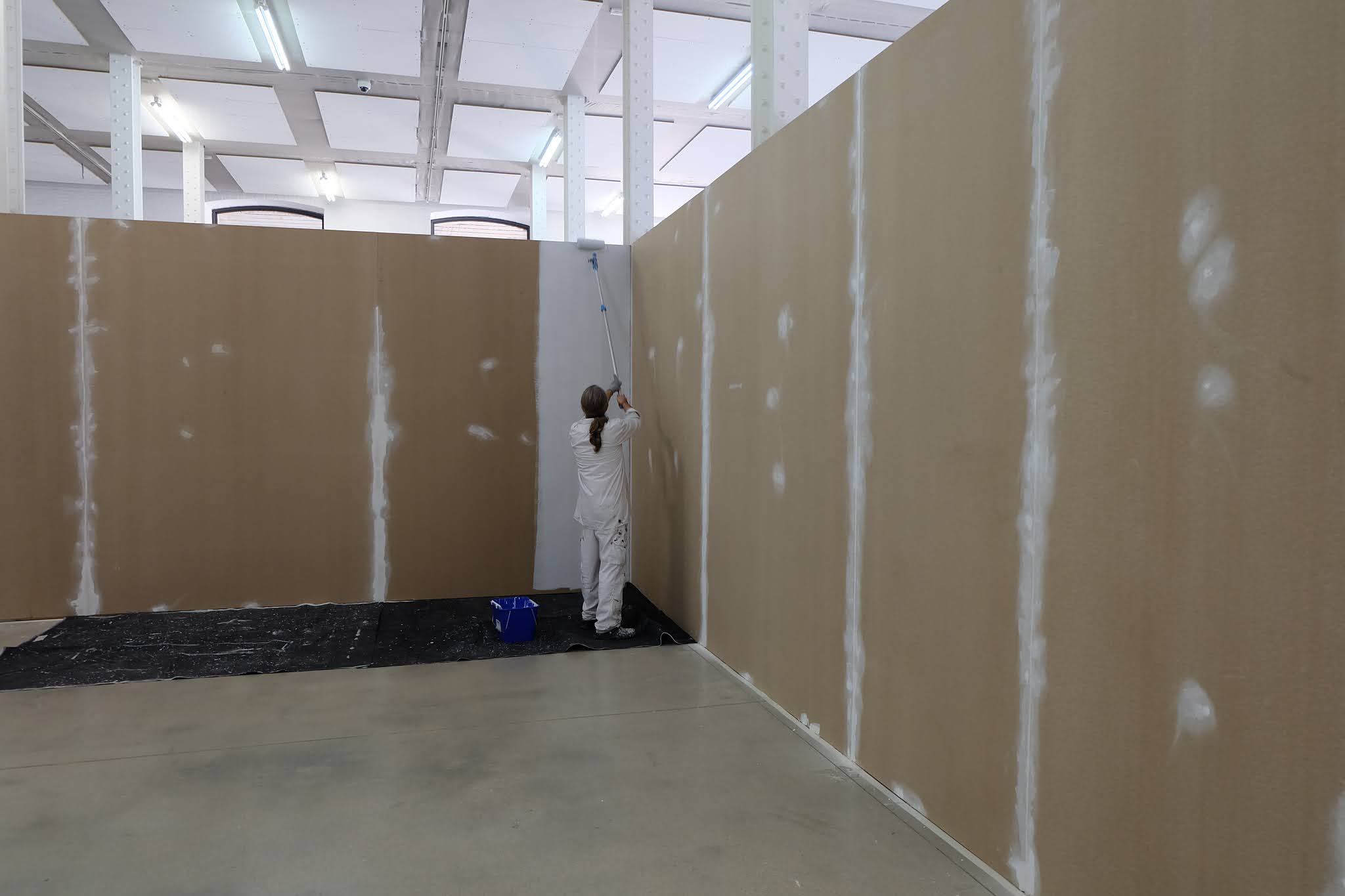
Painting by J. Roscolor.


(↑↓ Above and two below) Wall texts and vinyl production by DPR Producció i Exposicions.


17 October 2020: New restrictions against the spread of COVID-19 begin – bars and restaurants would end up closing for a month. The exhibition doors opened with little fanfare at Fabra i Coats although we were grateful that some familiar faces come to join us on this sunny autumn day.

With curators Veronica Valentini, Andrea Rodriguez and Anna Manubens (curator of Wendelien van Oldenborgh's exhibition on the first and second floor).
19 October 2021: Max’s (Contributing editor, frieze magazine since 2015) review of Eulàlia Rovira’s exhibition ‘Esmorteir l'esmorteït’ at EtHALL, L’Hospitalet de Llobregat (Barcelona) publishes on frieze online.

21 October 2020: 365 days left to open Panorama at MACBA. Co-curators are already in sync! #PanoramaMACBA

Hiuwai and Mariana taking a break after two Zoom conversations.

26 October 2020: Video call with Laia Estruch and MACBA’s Eva Font, Hiuwai Chu. #PanoramaMACBA


30 October 2020: New restrictions apply in Catalonia against the spread of COVID-19 provoking the cancellation of all the activities programmed for ‘Things Things Say’, most importantly the one-time screening of Adrià Julià’s ‘Popcorn’ (2012) at Zumzeig Cinema on November 6 – finally able to be rescheduled and screened on January 8, 2021. Guided tours planned for La Nit dels Museus on November 14 (as well as tours planned for November 25, rescheduled for December 9), all have been cancelled, as well as the weekend free tours of the exhibitions at Fabra i Coats: Contemporary Art Centre of Barcelona.

Adrià Julià, ‘Popcorn’ [Palomita], (2012). Vídeo HD, color, sonido. 90 min. Cortesía del artista.
13 November 2020: Continuing with online conversation-studio visits, this time with Arash Fayez. #PanoramaMACBA

23 November 2020: Site visit of Laia Estruch to MACBA to discuss options for her sculptural intervention for Panorama 21. #PanoramaMACBA


24 November 2020: Second round of photo documentation of the exhibition ‘Things Things Say’ / ‘Cosas que las cosas dicen’ / ‘Coses que les coses diuen’ at Fabra i Coats: Centre d'Art Contemporani de Barcelona, with photographer Eva Carasol.
→ Photo documentation of the show.

26 November–8 December 2020: One more year, we collaborate with DART Festival 2020 as jury members awarding the best national and international documentary: ‘Tierras construídas’ by Arturo Dueñas (España, 2019. 81 min. Castellano) and ‘The Proposal’ by Jill Magid (México, 2019. 82 min. Inglés). We are accompanied by film critic Quim Casas, and visual artist Jordi Colomer.

1 December 2020: Visiting Stella Rahola’s studio at Piramidón, with fantastic views over the city. #PanoramaMACBA


Photo: Eulàlia Rovira.

7 December 2020: Follow-up meeting with Arash Fayez at the museum. #PanoramaMACBA

10 December 2020: Recording a guided visit of the exhibition ‘Things Things Say’ on view at Fabra i Coats: Centre d'Art Contemporani de Barcelona as a proxy to the three cancelled guided visits of the show.

Photo: Mónica López.
21 December 2020: Meeting with Toni Hervàs to discuss his ongoing research around Paral·lel. #PanoramaMACBA

22 December 2020: New episode of Incidents (of Travel) from Singapore, following a tour set up by artists Fyerool Darma and Nurul Huda Rashid, and a report by curator Kathleen Ditzig. Incidents (of Travel) is an online project produced by KADIST that explores different corners of the world through chartered day-long travel itineraries as a form of artistic encounters and an extended conversation between a curator and an artist.
Read → incidents.kadist.org

2 January 2021: Always great to visit Rasmus Nilausen’s studio in L’Hospitalet and smell fresh oil paint.
#PanoramaMACBA


8 January 2021: Screening and Q&A of Adrià Julià’s feature film ‘Popcorn’ (2012 90') at cinema Zumzeig, part of the exhibition ‘Things Things Say’ ending on January 17, 2021.

9 January 2021: Catching up with Hiuwai in the metro on our way back from Fabra i Coats Centre d’Art Contemporani. #PanoramaMACBA


17 January 2021: ‘Things Things Say’ ends today. Lots of Instagram stories over the last week from visitors. Check social networks archive. Weeks after we learn that 1926 people visited the exhibition over the past three months which, considering pandemic restrictions, is great news. #ThingsThingsSay

18 January 2021: Dismantling of ‘Things Things Say’ exhibition. Always sad to say goodbye to works that have been so present in our minds over the last months. It is unavoidable to think about what remains of a show once it’s gone. In times of COVID-19, this feeling is intensified as fewer people might have had the opportunity to visit, regardless of the circumstances. #ThingsThingsSay


JBM Muntatges i produccions crew and Bea Montoliu (conservation) wrapping up the furniture loaned to form Haegue Yang's piece ‘VIP’s Union’ (2001-2020).


Lifting up the protective glass on Stuart Whipps’s table.

19 January 2021: Videoconference with Antoni Hervàs to talk about his contribution to Panorama 21. #PanoramaMACBA

21 January 2021: Video call with Rosa Tharrats to discuss details of her forthcoming installation at the museum. Around this date, Gabriel Ventura and the editorial team at Documents Documenta, kindly agreed to give us permission to borrow the title of their latest publication for the Panorama series: ‘Notes for an Eye Fire’, for which we are very grateful. #PanoramaMACBA

22 January 2021: Ruta de Autor tell us to meet nearby the Torre de les Aigües del Besòs, a water deposit built in 1882 by Pere Falqués and offering stunning panoramic views over the city – and a Blinky Palermo piece Himmelsrichtungen in the entrance space. The tower is the headquarters of the Arxiu Històric de Poblenou. #PanoramaMACBA


25 January 2021: Visiting the Centre d’Estudis i Documentació (CED) with Eulàlia Rovira, looking at maps, project proposals and photos of how MACBA was envisioned and ultimately built in the late 80s and early 90s. #PanoramaMACBA

Photo: Hiuwai Chu


Suitable photo albums from the former Panorama photo lab around town.
26 January 2021: Site visit with Claudia Pagès to MACBA to discuss her forthcoming participation in ‘Panorama 21: Apunts per a un incendi dels ulls’ (Notes for an Eye Fire). #PanoramaMACBA

27 January 2021: Once ‘Things Things Say’ is over and the galleries are empty once again. Eulàlia Rovira films ‘A Knot Which is Knot’ (2020-21), her contribution to the recently closed exhibition based on research done throughout the exhibition period, which will premiered a few days later, on February 15.

Photo: Eulàlia Rovira
29 January 2021: Online meeting with Bendita Gloria to go through the materials of the forthcoming publication of ‘Things Things Say’, the exhibition that just ended a few days ago at Fabra i Coats.
1 February 2021: Consecutive meetings with Toni Hervàs, Aleix Plademunt and Marria Pratts to discuss their projects on-site, alongside Eva Font (architecture department) and Berta Cervantes (Exhibition, Project Assistant). #PanoramaMACBA


9 February 2021: Live-streamed press conference announcing the 2021–22 season of the Museu d'Art Contemporani de Barcelona (MACBA). ‘Panorama 21. Apunts per a un incendi dels ulls’ is finally public. #PanoramaMACBA
→ Archive of social media posts.


12 February 2021: Panorama 21 “wefie” after a meeting with Rasmus Nilausen in Gràcia. #PanoramaMACBA

15 February 2021: Eulàlia Rovira’s video ‘A Knot Which is Knot’, 2020 (video, 12min 21 sec, audio in Catalan) is premièred on Fabra i Coats’ YouTube channel. ‘A Knot Which is Knot’ is the result of an investigation that began with the opening ‘Things Things Say’ (Fabra i Coats: Contemporary Art Center of Barcelona, 17 October 2020-17 January 2021), an exhibition curated by Latitudes, which is made public once it has closed and the exhibition galleries are once again empty.
→ Ver vídeo (12' 21'', audio in Catalan)
16 February 2021: First tech checks in the exhibition galleries with Rafa Marcos of El Palomar and MACBA’s A/V technician Miquel Giner, followed by a group meeting with Claudia Pagès to go catch up on her project.
#PanoramaMACBA


19 February 2021: Opening of Lara Almarcegui’s exhibition ‘Graves’ (Gravel) at the Centre d'Art La Panera in Lleida (on view until 30 May 2021). As part of the opening day events, Lara invited visitors to experience the quarry operated by Sorigué in La Plana del Corb, which stopped its operations for a day.
Latitudes contributed a text on her new installation and, on March 18 at 6:30pm, participated in a roundtable online discussion with the artist and Juan Guardiola. Due to mobility restrictions between municipalities, we couldn’t attend the opening.

View of Lara Almarcegui’s exhibition ‘Graves’ (Gravel) at the Centre d'Art La Panera in Lleida. Photo: Jordi V. Pou.
22 February 2021: Video call catch-up with Adrian Schindler (currently in residency at Casa Velázquez in Madrid until June 2021) to discuss his production for Panorama 21, followed by an in-person studio visit with Arash Fayez in Raval. #PanoramaMACBA

Trying to figure out the volume of works in the exhibition space.

2 March 2021: Running some tests of Aleix Plademunt’s work in the exhibition space while it’s empty between shows. #PanoramaMACBA


3 March 2021: Check-in meeting with Eulàlia Rovira on her ongoing research for her Panorama 21 contribution, followed by a site visit by Stella Rahola to check natural light. #PanoramaMACBA


8 Març 2021: Laia Estruch visit to discuss the production of her work in the middle of the installation of Felix Gonzalez-Torres show. #PanoramaMACBA

13 March 2021: First trip outside the city in exactly a year (tomorrow is the first anniversary of the declaration of the first state of alarm in Spain). Invited by the Centre d’Art La Panera in Lleida, we were able to attend the opening of David Bestué’s ‘Pastoral’ solo exhibition and Lara Almarcegui’s ‘Graves’ (for which we recently contributed the text of the exhibition). Forthcoming a frieze review of the exhibition by Max in the September 2021 issue.
 |
| (Above and below) Lara Almarcegui, ‘Gravera’ (2021), vídeo, 10 min. Cámara: Daniel Lacasa; y ‘Rocas y materiales de la Cordillera de los Pirineos’ (2021). Cortesía de la artista. |

 |
| (Above and below) Installation view of David Bestué’s ‘Pastoral’ at the Centre d'Art la Panera, Lleida. |

18 March 2021: Online conversation with Lara Almarcegui and Juan Guardiola on the occasion of Almarcegui’s solo show ‘Graves’ at Centre d’Art La Panera in Lleida.
 |
| During the conversation with Lara Almarcegui. 23 March 2021: Catch up with a provider for Laia Estruch’s installation and discussion of Panorama’s identity with graphic designer and ‘Panorama 21’ participant, Ana Domínguez. #PanoramaMACBA   29 March 2021: Morning meeting with Rasmus Nilausen and pm meeting with Gabriel Ventura and Rosa Tharrats to discuss the progress of their respective contributions for Panorama 21, titled after Gabriel’s latest book poem ‘Apunts per a un incendi dels ulls’ (Notes for an Eye Fire). #PanoramaMACBA   7, 14, 21 and 28 April 2021: Four reading groups are programmed this month as part of Adrian Schindler’s project to be presented as part of MACBA's inaugural Panorama exhibition in October 2021. These open-format groups constituted the last step before the production of his film Tetuan, Tetuán, تطوان , the first chapter of which will be shot in Barcelona in late Spring 2021. The reading group “A quienes la inspiraron y no la leerán: Goytisolo, Marruecos y el Otro” (To those who inspired it and will not read it: Goytisolo, Morocco and the Other) proposes a critical approach to the theoretical and fictional work of Spanish writer Juan Goytisolo (1931–2017), influenced by Morocco. Contrasting his ambition to deconstruct the Islamophobic literary tradition with the fantasies that inhabit his novels, we will address issues such as the construction of the image of the Other in Spain, the ghosts of the colonial project and the tensions inherent to decolonial works developed by white cultural agents. Participants read excerpts from the novels Reivindicación del conde Don Julián (1970), Juan sin tierra (1975) and Makbara (1980), as well as from the essay collection Crónicas Sarracinas (1981). The sessions were carried out with Salma Amzian, Núria Gómez Gabriel and Iki Yos Piña Narváez Funes, who contributed to examining Goytisolo’s contradictions and potentialities through other literatures and epistemologies. The meetings took place in the Parc de la Ciutadella, near a colonial monument and an orientalist sculpture. #PanoramaMACBA   2 April 2021: Video call with Claudia Pagès to check in the development of her project while at the Rijksakademie in Amsterdam. #PanoramaMACBA  7 April 2021: MACBA’s 2021-22 exhibition programme is up. Just over 6 months to the opening. #PanoramaMACBA  9 Abril 2021: Catch-up meetings with Ruta de Autor and Nyamnyam (from Montpellier). #PanoramaMACBA   12 April 2021: Publications meeting with Ana Domínguez. #PanoramaMACBA  13 April 2021: Meeting with Adrian Schindler at the museum’s offices to discuss the production of his work for MACBA’s ‘Panorama’. #PanoramaMACBA  15 April 2021: Monthly catch-up with the communication department with dazzling spreadsheets, followed by a visit to Stella Rahola Matutes's project at the Mies van der Rohe Pavilion. Curators’ outfits merging – too many hours together ;-) #PanoramaMACBA   22 April 2021: Design briefing with MACBA’s communication team, Marta Reus and Carla Ventosa, and Panorama 21 designers Ana Domínguez and Lara Coromina, about the exhibition. #PanoramaMACBA  |
30 April 2021: Meet with Arash Fayez and walk through the museum galleries with Ana Domínguez and Lara Coromina, designers of the first edition of MACBA’s Panorama.
#PanoramaMACBA


Photo: Hiuwai Chu


7 May 2021: Balcony break in between meetings with Eulàlia Rovira and Ruta de Autor. #PanoramaMACBA

Photo: Hiuwai Chu


8 May 2021: Presentation of Agustín Ortiz Herrera’s research ‘To name, to own. Critique of taxonomic practice’ project and publication at the Gabinet Salvador (Institut Botànic de Barcelona), one of the best-preserved examples of a cabinet of curiosities. Agustín’s research is one of the three projects Latitudes mentored throughout 2019–20 as part of the Barcelona Producció season at La Capella.
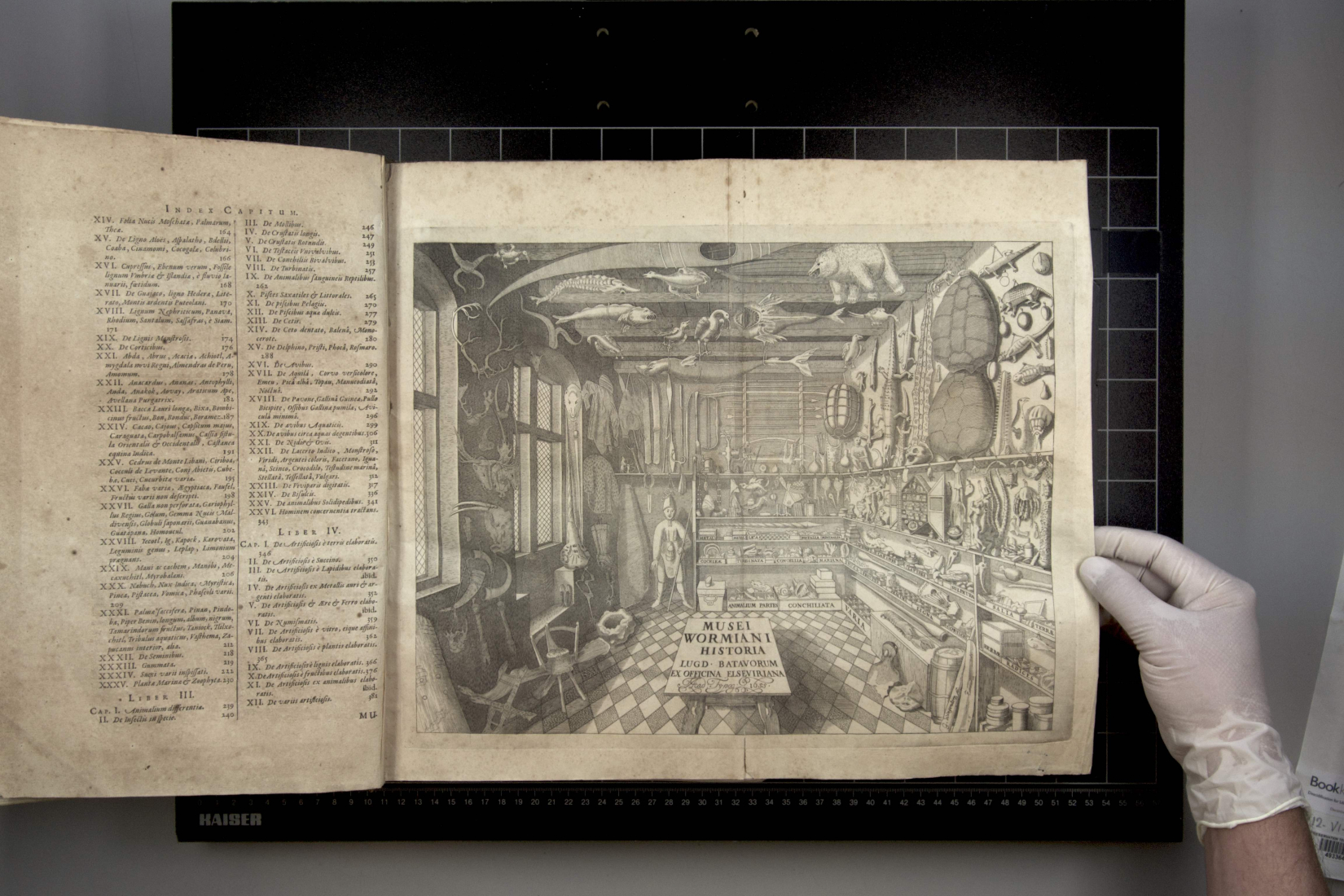
Representation of the cabinet of curiosities by the Danish naturalist and antiquarian Ole Worm in 1655. Salvador Library, Botanical Institute of Barcelona.
11 May 2021: Recording the teaser to be launched with the announcement of the participants in the inaugural Panorama exhibition. #PanoramaMACBA

12 May 2021: Review of David Bestué’s exhibition ‘Pastoral’ at the Centre d’Art la Panera, Lleida, published online at frieze.com

12 May 2021: Visiting Ana Dominguez studio and lunch with her and Lara Coromina to discuss the elements of the exhibition graphics. #PanoramaMACBA


Some artist portraits for the exhibition website.

17 May 2021: Jitsi catch-up with nyamnyam (Iñaki Álvarez and Ariadna Rodríguez) and Pedro Pineda. #PanoramaMACBA

20 May 2021: Catch up with Eulàlia Rovira at the museum. #PanoramaMACBA


22 May 2021: Laia Estruch rehearsing at El Graner. #PanoramaMACBA


Foto: Hiuwai Chu.

28 May 2021: Catch up with Ruta de Autor at the museum. #PanoramaMACBA

Photo: Hiuwai Chu.
1 June 2021: Work meeting at Rasmus Nilausen’s studio in L’Hospitalet. #PanoramaMACBA

4 June 2021: Final presentation of the graphic image of Panorama 21 by Studio Ana Dominguez. #PanoramaMACBA

7 June 2021: Meeting at TMDC in La Verneda with Pedro Pineda and nyamnyam (Ariadna Rodríguez & Iñaki Álvarez). #PanoramaMACBA


Photo: Hiuwai Chu.


8 June 2021: Visiting Rosa Tharrats and Gabriel Ventura in Cadaqués and visiting Rosa’s two-person exhibition in the Museu de l’Empordà, Figueres. #PanoramaMACBA

View of the two-person exhibition ‘Tura Sanglas/ Rosa Tharrats: Un diàleg artistic. Subjectivitat de la material, poètica de l’objecte’, curated by Laura Cornejo at Museu de l’Empordà.

‘Les babes de la molsa’ (2020) by Rosa Tharrats.

‘Els ancestres de les anênomes’ (2020) by Rosa Tharrats.

Photo: Ivo Wald.


Photo: Ivo Wald.

Meetings by the shore.
10 June 2021: Visiting Marria Pratts’ studio in L’Hospitalet. #PanoramaMACBA

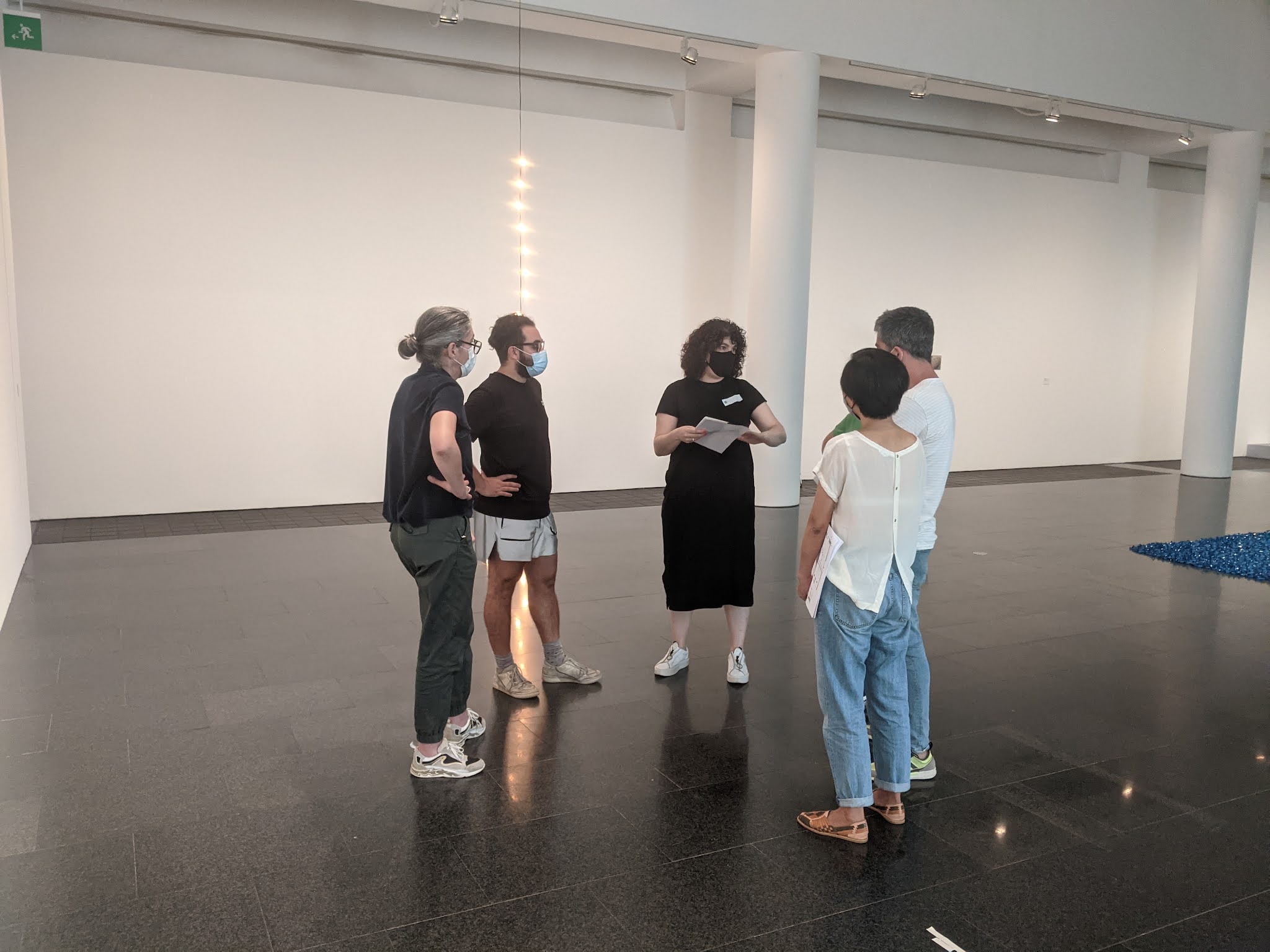

18 June 2021: Round of meetings with nyamnyam followed by Ruta de Autor and Stella Rahola at the museum. #PanoramaMACBA


22 June 2021: Adrian Schindler filming Tetuan, Tetuán, تطوان at Plaça Tetuan. Schindler's project will be presented as part of MACBA’s inaugural Panorama exhibition in October 2021. #PanoramaMACBA


1 July 2021: Announcement of ‘Notes for an Eye Fire’ participants, launch of the web with the graphic image of the Panorama exhibition series: Ana Domínguez, El Palomar (Mariokissme & R. Marcos Mota), Laia Estruch, Arash Fayez, Antoni Hervàs, Rasmus Nilausen, nyamnyam (Ariadna Rodríguez & Iñaki Álvarez) with Pedro Pineda, Claudia Pagès, Aleix Plademunt, Marria Pratts, Stella Rahola Matutes, Eulàlia Rovira, Ruta de autor (Aymara Arreaza R. & Lorena Bou Linhares), Adrian Schindler, Rosa Tharrats, Gabriel Ventura, and Marc Vives. #PanoramaMACBA


6 July 2021: Online catch-up with public programmes Tonina Cerdà and Alicia Escobio. #PanoramaMACBA


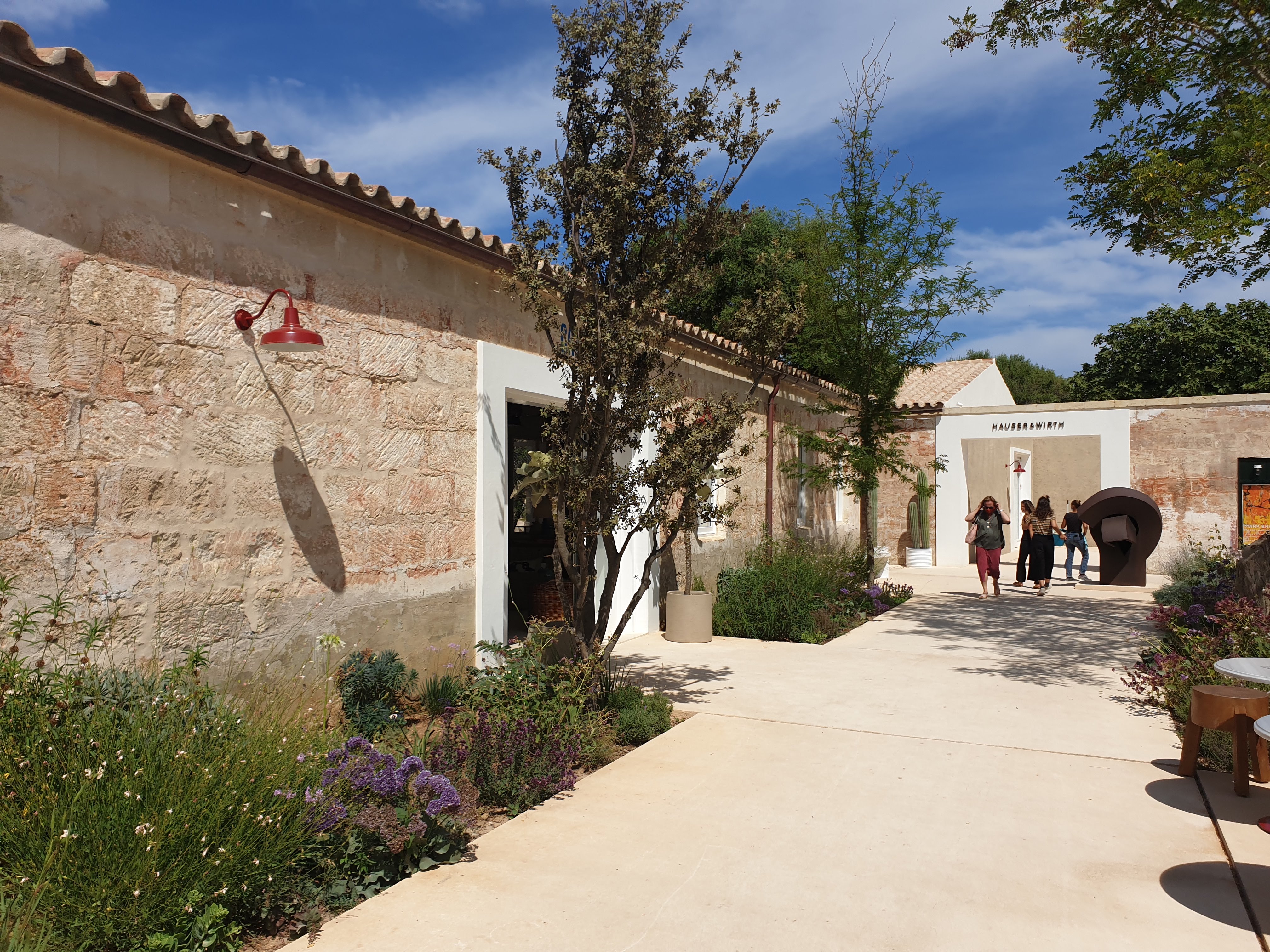


Carlos Cruz-Diez at Galería Cayón, Maó.
17 July 2021: Rough cut screening of Adrian Schindler’s filmTetuan, Tetuán, تطوان to be premiered as part of MACBA’s inaugural Panorama exhibition in October 2021. #PanoramaMACBA

Photo: Hiuwai Chu.
26 July 2021: Visiting Toni Hervàs at La Escocesa alongside MACBA’s team Alex Castro, Eva Font and Berta Cervantes (conservation, architecture and coordination). #PanoramaMACBA


→ RELATED CONTENTS:
- Latitudes’ "out of office" 2019–20 season, 3 August 2020
- Latitudes’ "out of office" 2018–19 season, 1 August 2019
- Latitudes' "out of office" 2017–18 season, 2 August 2018
- Latitudes "out of office" 2016–17 season, 1 August 2017
- Latitudes' "out of office" 2015–16 season, 1 August 2016
- Latitudes' "out of office" 2014–15 season, 7 August 2015
- Latitudes' "out of office" 2013–14 season, 31 July 2014
- Latitudes' "out of office" 2012–13 season, 31 July 2013
- Latitudes' "out of office" 2011–12 season, 31 July 2012
- Latitudes' "out of office" 2010–11 season, 1 August 2011
- Latitudes' "out of office" 2009–10 season, 30 July 2010
- Latitudes' "out of office" 2008–9 season, 30 July 2009
2020 in 11 monthly Cover Stories
Mon, Dec 28 2020Since Spring 2015, Latitudes has published a monthly cover story on its homepage www.lttds.org featuring past, present or forthcoming projects, as well as ongoing research, texts, artworks, exhibitions, films, objects or travel related to our curatorial practice. Here's how 2020 looked like on our homepage.
#Latitudes15Years, 2020, art-agenda, Barcelona Producció, cover story, Incidents of Travel, latitudes, looking back, Projects, things things say, writing


Research project ‘Naming, possessing Critique of taxonomic practice’ by Agustín Ortiz Herrera, Barcelona Producció 2019–2020
Wed, Oct 21 2020
Photo: Agustín Ortiz Herrera
As part of Agustín Ortiz Herrera's research project ‘Naming, possessing Critique of taxonomic practice’, awarded the grant Barcelona Producció 2019-2020 from La Capella (and one of the three projects mentored by Latitudes throughout the 2019–20 season), and organised in collaboration with Hangar's Fictions of Dis-order programme, Ortiz Herrera presents a series of guided tours and reading sessions where queer strategies will be questioning the narratives agreed upon by the modern scientific construct, introducing a decolonial narrative, and thus unveiling the secrets of plant species such as Sparrmannia, Washingtonia or Tulbaghia.
‘The colonial garden. Deconstructing the narratives of modern taxonomy’

Agustín Ortiz Herrera
To Name, To Own. Critique of Taxonomic Practice
Research Project
1 Linnaeus was the first to use it consistently throughout his book, although the system now known as binomial nomenclature was partially developed by the brothers Gaspard and Johann Bauhin 200 years earlier.
2 Linnaeus published 12 editions of Systema Naturae during his lifetime. The 10th edition from 1758 is considered the starting point of zoological nomenclature.
3 Sir James Edward Smith purchased Linnaeus’s botanical, zoological and library collections for 1,000 guineas to found The Linnean Society of London in 1788. It was at a meeting of the Society in 1858 that papers from Charles Darwin and Alfred Russel Wallace outlining the theory of evolution by natural selection were first presented. https://www.linnean.org
4 The Salvador family were a dynasty of apothecaries and naturalists from Barcelona that between the 17th and 19th centuries collected over 14,000 specimens. The Gabinet Salvador is the most important example of a Cabinet of Curiosities or wunderkammer in the country, a presentation format which predates the invention of the modern museum and the separation between the sciences and the humanities. https://museuciencies.cat/es/area-cientifica/colecciones/coleccion-salvador/
5 With its origins in the 17th century, the Gabinet Salvador includes the oldest known herbarium in Spain, as well as books, documents, collections of molluscs, fossils, and stuffed animals. The Zoology Museum of Barcelona was located in the Modernista building known as the ‘Castle of the Three Dragons’ between 1920 and 2010 when it was relocated and changed its name to Museu de Ciències Naturals de Barcelona (Museum of Natural Sciences of Barcelona, aka the ‘Museu Blau’).
6 Teresa Castro, The Mediated Plant, e-flux Journal #102, September 2019, https://www.e-flux.com/journal/102/283819/the-mediated-plant/
7 Emanuele Coccia, The Life of Plants: A Metaphysics of Mixture, Polity Press, 2018.
‘The colonial garden. Deconstructing the narratives of modern taxonomy’
Activity: Urban Route around the streets of Poblenou
Date: Friday 23 October 2020, 6–7:30 pm
Ortiz Herrera invites us to join him on a tour that aims to bring to light forgotten episodes in the development of botanical knowledge during the modern project while experimenting with queer/cuir confrontation strategies.
Meeting place to be confirmed. Participants will be notified.
Capacity: 20 people.
Date: Friday 23 October 2020, 6–7:30 pm
Ortiz Herrera invites us to join him on a tour that aims to bring to light forgotten episodes in the development of botanical knowledge during the modern project while experimenting with queer/cuir confrontation strategies.
Meeting place to be confirmed. Participants will be notified.
Capacity: 20 people.
Booking essential: lacapella@bcn.cat
Activity: Guided tour of the Barcelona Botanical Gardens
Date: Saturday 24 October 2020,11.30–13:30 am
During this second dérive, historical events will be explained using a methodology of situated knowledge that exposes the scale of the strategy of the cabinet of curiosities in botanical gardens.
Meeting place to be confirmed. Participants will be notified.
Capacity: 20 people.
Activity: Guided tour of the Barcelona Botanical Gardens
Date: Saturday 24 October 2020,11.30–13:30 am
During this second dérive, historical events will be explained using a methodology of situated knowledge that exposes the scale of the strategy of the cabinet of curiosities in botanical gardens.
Meeting place to be confirmed. Participants will be notified.
Capacity: 20 people.
Booking essential: lacapella@bcn.cat
Activity: Modern Nature: a tribute to Derek Jarman
Date: Thursday 5 November 2020, 6–8 pm
Activity: Modern Nature: a tribute to Derek Jarman
Date: Thursday 5 November 2020, 6–8 pm
Location: Hangar (Sala Ricson)
Reading group and discussion around Derek Jarman’s book Modern Nature. We will also be talking about Jarman’s film The Garden (1990) and his design for his garden at Prospect Cottage in the south-east of England.
Capacity: 40 people.
Reading group and discussion around Derek Jarman’s book Modern Nature. We will also be talking about Jarman’s film The Garden (1990) and his design for his garden at Prospect Cottage in the south-east of England.
Capacity: 40 people.
Booking essential: https://forms.gle/4MQQXy72SwBxpV6V7
Organised by Hangar. With the support of Caja Negra Editorial.
Organised by Hangar. With the support of Caja Negra Editorial.
Agustín Ortiz Herrera (Barcelona, 1970) works between moving image and performance. He studied Fine Arts at the University of Barcelona (1998), film-making in New York (2003) and obtained an MA in Fine Arts at the Konstfack College of Arts, Stockholm (2016). Recent exhibitions include Oblivion at K.R.O.P.P., Uppsala Konsert & Kongress, Uppsala (2019), Konst tar plats at Österbybruk, Sweden (2018), Potenciación a largo plazo at Paratext 24, Hangar, Barcelona (2017) and El umbral de primavera, Madrid (2018). He is currently resident at Hangar – Visual Arts Production and Research Centre in Barcelona.
Co-produced in the context of the “Fictions of Dis-order” programme of Hangar's Research and Transfer of Knowledges activities.
Co-produced in the context of the “Fictions of Dis-order” programme of Hangar's Research and Transfer of Knowledges activities.
Agustín Ortiz Herrera, Laboratori de Natura, Museu de Ciències Naturals de Barcelona, Video Still, 2020.
To Name, To Own. Critique of Taxonomic Practice
Research Project
Barcelona Producció 2019–2020
→ Download this text as a pdf
Agustín Ortiz Herrera’s research project To Name, To Own. Critique of Taxonomic Practice focuses on taxonomy and the modern classification system for natural species developed by Swedish botanist, zoologist, and physician Carl Linnaeus (1707–1778). Linnaeus’s most notable contribution to science was his invention of a system of binomial nomenclature for naming organisms. For example, the two-term name Homo sapiens describes the only living species of the genus Homo: humans. This convention became universally accepted and the nested hierarchy became quickly consolidated as the dominant cognitive basis of the Western worldview of nature.[1] Linnaeus’s 1735 volume Systema Naturae not only classified the natural world, it also gendered it and thereby conditioned an understanding of natural history as a highly patriarchal structure. This condition has transcended science and come to dominate other fields of culture and knowledge.[2]
Ortiz has carried out his research in botanical collections, academic centres, and libraries specialising in Linnaeus’s scientific work located in Uppsala, Sweden (where Linnaeus ultimately became rector of the city’s university) and London (where the world’s oldest active biological society, The Linnean Society of London, was established in 1788).[3] Honouring the Society’s motto “Naturae Discere Mores” (To Learn the Ways of Nature), Ortiz furthermore connects Linnaeus’s legacy with two key nodes of research in Spain: the Gabinet Salvador at the Botanical Institute of Barcelona and the former Museum of Zoology in Barcelona’s Ciutadella Park.[4] In doing so he aims to bring taxonomic paradigms into the present and to critique them against recent and emerging post-human, queer, feminist and decolonial theories.[5]
Taking up Teresa Castro’s call for “queering nature” and “queering botanics”, Ortiz’s research refuses the anthropocentric and dualistic conception that has separated humans from non-humans in order to go beyond the constraints of Western exceptionalism and its colonising grip.[6] Castro has identified a “plant turn” in current fields of knowledge and creation, where philosophers including Emanuele Coccia are inviting us to think about and with vegetation or fungi and to consider herbivorous or fungal relations and non-hierarchical modes of being. Such an approach chimes with the Brazilian anthropologist Eduardo Viveiros de Castro’s call for “decolonising thought” and to contest the hierarchical relationships between “our” thoughts and those of others.[7]
Another important point of Ortiz’s research has been foregrounding the scientific work of Lynn Margulis (1938–2011), the unorthodox scientist whose theories around evolution and symbiosis were often mocked and ignored by the male establishment for appearing to contradict Charles Darwin’s dogma of natural selection. As a proponent of the endosymbiotic theory, Margulis posited that simple life forms merged, forming cell organelles, like mitochondria. Life, she believed, is a symbiotic and cooperative union that allows those who associate to succeed, a theory that later has been widely accepted and substantiated.
Ortiz’s research introduces queer epistemologies through a series of gatherings, an urban walking tour and a collective reading. The first will be a two-hour guided tour around Poblenou to identify and discuss plant taxonomy and its colonial provenance. A similar tour will take place the following day in Montjuïc’s Botanical Garden, where Agustín will lead a discussion within the framework of a man-made “natural” environment.
A third activity, developed in collaboration with Hangar – Visual Arts Production and Research Centre in Barcelona as part of its Fictions of Dis-order programme, will consist of a collective reading of Derek Jarman’s Modern Nature. Published in 1991, this biography is a diary of the British film-maker, artist and activist on his late years at Prospect Cottage, on the arid Kent coast in south-east England. Jarman purchased this fisherman’s house in Dungeness in 1986 shortly after being diagnosed as HIV positive, with the aim of withdrawing in the years before his death (in 1994). The now-iconic black timber cottage with yolk yellow window frames is overlooked by the imposing Dungeness nuclear power station and surrounded by a vast shingle beach and a noteworthy garden, the boundaries of which he described as the horizon.
— Latitudes
Agustín Ortiz Herrera’s research project To Name, To Own. Critique of Taxonomic Practice focuses on taxonomy and the modern classification system for natural species developed by Swedish botanist, zoologist, and physician Carl Linnaeus (1707–1778). Linnaeus’s most notable contribution to science was his invention of a system of binomial nomenclature for naming organisms. For example, the two-term name Homo sapiens describes the only living species of the genus Homo: humans. This convention became universally accepted and the nested hierarchy became quickly consolidated as the dominant cognitive basis of the Western worldview of nature.[1] Linnaeus’s 1735 volume Systema Naturae not only classified the natural world, it also gendered it and thereby conditioned an understanding of natural history as a highly patriarchal structure. This condition has transcended science and come to dominate other fields of culture and knowledge.[2]
Ortiz has carried out his research in botanical collections, academic centres, and libraries specialising in Linnaeus’s scientific work located in Uppsala, Sweden (where Linnaeus ultimately became rector of the city’s university) and London (where the world’s oldest active biological society, The Linnean Society of London, was established in 1788).[3] Honouring the Society’s motto “Naturae Discere Mores” (To Learn the Ways of Nature), Ortiz furthermore connects Linnaeus’s legacy with two key nodes of research in Spain: the Gabinet Salvador at the Botanical Institute of Barcelona and the former Museum of Zoology in Barcelona’s Ciutadella Park.[4] In doing so he aims to bring taxonomic paradigms into the present and to critique them against recent and emerging post-human, queer, feminist and decolonial theories.[5]
Taking up Teresa Castro’s call for “queering nature” and “queering botanics”, Ortiz’s research refuses the anthropocentric and dualistic conception that has separated humans from non-humans in order to go beyond the constraints of Western exceptionalism and its colonising grip.[6] Castro has identified a “plant turn” in current fields of knowledge and creation, where philosophers including Emanuele Coccia are inviting us to think about and with vegetation or fungi and to consider herbivorous or fungal relations and non-hierarchical modes of being. Such an approach chimes with the Brazilian anthropologist Eduardo Viveiros de Castro’s call for “decolonising thought” and to contest the hierarchical relationships between “our” thoughts and those of others.[7]
Another important point of Ortiz’s research has been foregrounding the scientific work of Lynn Margulis (1938–2011), the unorthodox scientist whose theories around evolution and symbiosis were often mocked and ignored by the male establishment for appearing to contradict Charles Darwin’s dogma of natural selection. As a proponent of the endosymbiotic theory, Margulis posited that simple life forms merged, forming cell organelles, like mitochondria. Life, she believed, is a symbiotic and cooperative union that allows those who associate to succeed, a theory that later has been widely accepted and substantiated.
Ortiz’s research introduces queer epistemologies through a series of gatherings, an urban walking tour and a collective reading. The first will be a two-hour guided tour around Poblenou to identify and discuss plant taxonomy and its colonial provenance. A similar tour will take place the following day in Montjuïc’s Botanical Garden, where Agustín will lead a discussion within the framework of a man-made “natural” environment.
A third activity, developed in collaboration with Hangar – Visual Arts Production and Research Centre in Barcelona as part of its Fictions of Dis-order programme, will consist of a collective reading of Derek Jarman’s Modern Nature. Published in 1991, this biography is a diary of the British film-maker, artist and activist on his late years at Prospect Cottage, on the arid Kent coast in south-east England. Jarman purchased this fisherman’s house in Dungeness in 1986 shortly after being diagnosed as HIV positive, with the aim of withdrawing in the years before his death (in 1994). The now-iconic black timber cottage with yolk yellow window frames is overlooked by the imposing Dungeness nuclear power station and surrounded by a vast shingle beach and a noteworthy garden, the boundaries of which he described as the horizon.
— Latitudes
1 Linnaeus was the first to use it consistently throughout his book, although the system now known as binomial nomenclature was partially developed by the brothers Gaspard and Johann Bauhin 200 years earlier.
2 Linnaeus published 12 editions of Systema Naturae during his lifetime. The 10th edition from 1758 is considered the starting point of zoological nomenclature.
3 Sir James Edward Smith purchased Linnaeus’s botanical, zoological and library collections for 1,000 guineas to found The Linnean Society of London in 1788. It was at a meeting of the Society in 1858 that papers from Charles Darwin and Alfred Russel Wallace outlining the theory of evolution by natural selection were first presented. https://www.linnean.org
4 The Salvador family were a dynasty of apothecaries and naturalists from Barcelona that between the 17th and 19th centuries collected over 14,000 specimens. The Gabinet Salvador is the most important example of a Cabinet of Curiosities or wunderkammer in the country, a presentation format which predates the invention of the modern museum and the separation between the sciences and the humanities. https://museuciencies.cat/es/area-cientifica/colecciones/coleccion-salvador/
5 With its origins in the 17th century, the Gabinet Salvador includes the oldest known herbarium in Spain, as well as books, documents, collections of molluscs, fossils, and stuffed animals. The Zoology Museum of Barcelona was located in the Modernista building known as the ‘Castle of the Three Dragons’ between 1920 and 2010 when it was relocated and changed its name to Museu de Ciències Naturals de Barcelona (Museum of Natural Sciences of Barcelona, aka the ‘Museu Blau’).
6 Teresa Castro, The Mediated Plant, e-flux Journal #102, September 2019, https://www.e-flux.com/journal/102/283819/the-mediated-plant/
7 Emanuele Coccia, The Life of Plants: A Metaphysics of Mixture, Polity Press, 2018.
→ RELATED CONTENTS:
15 septiembre 2020, 19.30h: Charla entre Rosa Maria Subirana Torrent y Lola Lasurt
Thu, Sep 10 2020
Foto: Ralph Herrmanns. MNAC, 1972. Archivo personal de Rosa Maria Subirana Torrent.
Actividad: Del Año Miró (1968) al inventario de la donación. Charla entre Rosa Maria Subirana Torrent y Lola Lasurt
Modera: Ángel Calvo Ulloa
Fecha: 15 de septiembre de 2020, de 19 a 21 h. Incluye una visita guiada a la exposición de 19 a 19.30h
Reserva: Aforo limitado. Imprescindible inscripción previa en lacapella@bcn.cat
Lugar: La Capella (c. Hospital 56, Barcelona)
Streaming en directo a partir de las 19.30h en el canal YouTube de Barcelona Cultura (duración: 1h 16min).
En el marco de la exposición Juego de niños, Lola Lasurt conversa con Rosa Maria Subirana Torrent, conservadora de los Museos de la Ciudad de Barcelona durante los últimos años de dictadura y testigo de primera mano del inicio de la gestión institucional del arte contemporáneo en Cataluña.
Bajo las órdenes del consistorio barcelonés, Subirana inventarió meticulosamente los fondos de las primeras colecciones de arte contemporáneo cedidas a la ciudad y coordinó el Año Miró, en el que se inscribió la organización de la exposición retrospectiva en el recinto del antiguo Hospital de la Santa Creu en 1968, así como otras actividades, entre ellas la colocación de una placa en el pasaje del Crèdit (donde nació Miró en 1893) y el Premio Miró para niños.
Miró donó a la ciudad parte de las obras presentadas en la exposición, que fueron trasladadas al Museu Nacional d'Art de Catalunya (MNAC) para ser inventariadas y constituir el futuro fondo del CEAC (Centro de Estudios de Arte Contemporáneo), el edificio ideado por Josep Lluís Sert que se inauguró en 1975 en Montjuïc.
Esta actividad es parte del programa de mediación εξέδρα (exedra) dirigido por Jordi Ferreiro para la temporada Barcelona Producció 2019–20 de La Capella. Juego de niños de Lola Lasurt ha sido tutorizado por Latitudes.
 (📷 ↑↓) Vistas de la exposición ‘Juego de niños’ de Lola Lasurt en La Capella. Fotos: Pep Herrero.


→ RELATED CONTENT:
- Proyectos tutorizados en Barcelona Producció 2019–2020
- Cover Story—September 2020: States of emergency—Lola Lasurt’s ‘Children’s Game’, 1 Sep 2020
- Ressenya exposició – ‘Lola Lasurt i la lactància democràtica’, Clàudia Rius, nuvol.com, 22 juliol 2020
- Exposición ‘Juego de niños’ de Lola Lasurt, Barcelona Producció 2019-2020, 21 julio–27 septiembre 2020. 13 Jul 2020
- Video exposició, Canal Barcelona Cultura
- Jurado y tutoría de Barcelona Producció 2019–2020: Proyectos ganadores, 03 Jun 2019
- ‘Donació’ proyecto de Lola Lasurt para el Barcelona Gallery Weekend 2016 – info y fotografías
- ‘Compositions’ a programme of five artists' interventions for the second Barcelona Gallery Weekend, 29 September–2 October 2016, 20 Sep 2016
Cover Story—September 2020: States of emergency—Lola Lasurt’s ‘Children’s Game’
Tue, Sep 1 2020
Latitudes' homepage www.lttds.org
The September 2020 monthly Cover Story ‘States of emergency—Lola Lasurt’s ‘Children’s Game’’ is now up on our homepage: www.lttds.org
“Lola Lasurt’s exhibition ‘Joc d'infants’ (Children’s Game) looks back more than fifty years to the first contemporary art event hosted in the same venue where it is now taking place—until 27 September.”
→ Continue reading
→ After September 2020 this story will be archived here.
Cover Stories' are published on a monthly basis on Latitudes' homepage featuring past, present or forthcoming projects, research, texts, artworks, exhibitions, films, objects or field trips related to our curatorial projects and activities.
→ RELATED CONTENTS:
→ After September 2020 this story will be archived here.
Cover Stories' are published on a monthly basis on Latitudes' homepage featuring past, present or forthcoming projects, research, texts, artworks, exhibitions, films, objects or field trips related to our curatorial projects and activities.
→ RELATED CONTENTS:
- Archive of Monthly Cover Stories
- Cover Story—August 2020: ‘Màquina possible’: going viral at Can Balaguer 1 Aug 2020
- Cover Story—July 2020: Nino Kvrivishvili’s silk roads: Incidents (of Travel), Tbilisi 1 Jul 2020
- Cover Story—June 2020: Mataró Chauffeur Service, since 2010 1 June 2020
- Cover Story—May 2020: Panama, back through the lens 4 May 2020
- Cover Story—March-April 2020: The Bolós Cabinet 3 March 2020
- Cover Story—February 2020: Carioca Incidents 3 February 2020
- Cover Story—January 2020: Safeguarding Gestures 2 January 2020
Latitudes’ “Out of office”: wrap up of the 2019–20 season
Mon, Aug 3 2020
Seen in l'Hospitalet de Llobregat. Photo: @marianacanepaluna
In what has now become something of a Latitudes’ tradition we wrap up the season with a retrospective glance behind the scenes of some of our projects and activities of the previous twelve months (see the 2008-9, 2009-10, 2010-11, 2011-12, 2012–13, 2013–14, 2014–15, 2015–16, 2016–17, 2017–18 and 2018–19 posts). This last year has of course been unprecedented in so many ways. From mid-March, the Covid-19 pandemic meant that everything that had been in place was suddenly thrown into permanent doubt, delayed, or simply cancelled. As a healthcare crisis now precipitates an economic crisis, and with things we once took for granted (among them international travel, and visiting physical art exhibitions) completely changed for the foreseeable future, it is with more than a little trepidation that we even dare to look back at what once seemed normal.
Keep well, keep safe.
#DistanciaManosMascarilla
#DistànciaMansMascareta
September 1, 2019: New season, new month, new cover story. ‘Polperro to Detroit’ tracked the improbable connection between Polperro, a small town Latitudes passed through on its summer sojourn, and an American Rust Belt metropolis we would be visiting later this September as participants of the Red Bull Arts Global Curatorial Initiative: Detroit.

September monthly Cover Story on https://www.lttds.org/coverstory
September 9–15, 2019: Beginning of the 2019–2020 season. This was our first trip to Helsinki where we were participating in two events. Firstly Latitudes was a partner organisation in the arts festival ‘Today Is Our Tomorrow’, a three-day event (12, 13 and 14 September) initiated by PUBLICS that presented a collaboratively curated program of temporary public art commissions, live performance, music, dance, theatre, literature and symposia. Latitudes invited Mercedes Azpilicueta to present her performance ‘Yegua-yeta-yuta’ (2015) at Club Kaiku, an underground music venue renowned for hosting an innovative lineup of DJs.
We were also guests of Frame Contemporary Art Finland’s Gathering for Rehearsing Hospitalities’, a week composed of talks, performative dialogues, interventions and screenings developed in collaboration with a number of local partners.

‘Gathering for Rehearsing Hospitalities’ organised by Frame Contemporary Art Finland, hosted at the Museum of Impossible Forms.

September 12, 5:30h: Mercedes Azpilicueta during her talk in Helsinki.

Inga Lace’s Instagram Stories documenting the conversation between Mercedes and Latitudes on September 13, 2019.

Mercedes during her rehearsal at Club Kaiku.

Mercedes and Max in the ferry to Suomenlinna Island to visit HIAP and a film installation by Marjolijn Dijkman and & Toril Johannessen.

With Jussi Koitela (Head of Programme, Frame Contemporary Art Finland) and curators Anne-Sophie Springer and Sofia Lemos in HIAP's office space in Suomenlinna island.

Listening to Wet Code, a sound piece by Myriagon at Suomenlinna Island. Photo by Ida Enegren / Frame Contemporary Art Finland.

On top of the Temppeliaukion Kirkko (A church built into rock) with Anne-Sophie Springer and Sofia Lemos.

Our October 2019 cover story featured Azpilicueta's performance programmed during TODAY IS OUR TOMORROW.

PUBLICS' Library in Helsinki incorporated Latitudes-edited publications to their beautiful shelves in Vallila, Helsinki.

September 18–23, 2019: Joined the 2019 EXPO CHICAGO/Red Bull Arts Global Curatorial Initiative participating in a range of events and visits in Chicago (18–21 September) and Detroit (21–23 September).
→ Read the photo report here.


→ Read the photo report here.
Caught purchasing books during our visit to ExpoChicago's section Index Art Book Fair. Photo: Casa Bosques.
Morning session with the participating curators in the EXPO CHICAGO/Red Bull Arts Global Curatorial Initiative together with the Art Institute curatorial staff at the Art Institute Chicago. Photo: Expo Chicago.
The first stop in Detroit was visiting Dabls’ African Bead Gallery where we met its creator, Olayami Dabls led by our fantastic host Scott Campbell, Artist Liaison at Red Bull Arts Detroit, accompanied also by curator Maria Inés Rodríguez.
Laura Mott (Senior Curator of Contemporary Art and Design) leading a tour of her curated exhibition ‘Landlord Colors: On Art, Economy, and Materiality’ at the Cranbrook Art Museum. Painting by Yoan Capote.
September 20, 2019: Meanwhile in Copenhagen, Rasmus Nilausen's solo exhibition ‘Bluetooth’ opened at Overgaden. Institut for Samtidskunst, Copenhagen, for which Max contributed an essay.
→ Exhibition views and text (pdf).

→ Exhibition views and text (pdf).
(↑↓) Views from Nilausen's exhibition at Overgarden, Copenhagen. Photos: Anders Sune Berg.

October 7, 2019: artfridge.de published the interview Helene Romakin conducted with us over the summer.
→ Read the interview.

→ Read the interview.
artfridge.de
October 9, 2019: The artist Céline Mathieu (and former BAR TOOL #2 participant) published an article in the Belgian magazine HART on the Barcelona art scene mentioning Latitudes and our three closed-door sessions ‘Barcelona / Such a beautiful horizon: Critical social infrastructure to promote art scene health resilience’ Latitudes led with BAR Tool's 2018–19 participants.

October 17-19, 2019: Lecture ‘4.543 billion and abstract social nature’, Jornadas Eremuak, AzkunaZentroa, Bilbao. Taking as a reference point one of the ten galleries hosting the 2017 group exhibition ‘4,543 billion. The matter of matter’ at the CAPC musée d’art contemporain de Bordeaux, we expanded on the notion of ‘abstract social nature’ coined by environmental historian and geographer Jason W. Moore through the work of four exhibiting artists: Lara Almarcegui, Pep Vidal, Lucas Ihlein and Amy Balkin.
→ Video presentation here (Spanish, 24'45'')
→ Q&A session here (Spanish, 19'52'').

October 23, 2019: First meeting with Joan Morey to discuss the adaptation of his retrospective exhibition COLLAPSE for Casal Solleric in Palma de Mallorca, opening at the end of January. Time is of the essence.

November 1, 2019: Max Andrews’s feature-length article ‘The Rise, Fall and Reinvention of Spain’s First Modern Art Museum’ on Valencia’s IVAM was published in the November–December 2019 (issue 207) of frieze magazine. The article focuses on the city’s trailblazing Institut Valencià d’Art Modern (IVAM) through the cultural and (often notorious) political agents that have forged its institutional history since it opened in 1989.
→ Featured as our November 2019 Cover Story.

October 17-19, 2019: Lecture ‘4.543 billion and abstract social nature’, Jornadas Eremuak, AzkunaZentroa, Bilbao. Taking as a reference point one of the ten galleries hosting the 2017 group exhibition ‘4,543 billion. The matter of matter’ at the CAPC musée d’art contemporain de Bordeaux, we expanded on the notion of ‘abstract social nature’ coined by environmental historian and geographer Jason W. Moore through the work of four exhibiting artists: Lara Almarcegui, Pep Vidal, Lucas Ihlein and Amy Balkin.
→ Video presentation here (Spanish, 24'45'')
→ Q&A session here (Spanish, 19'52'').
Photo: Eremuak.
October 23, 2019: First meeting with Joan Morey to discuss the adaptation of his retrospective exhibition COLLAPSE for Casal Solleric in Palma de Mallorca, opening at the end of January. Time is of the essence.
November 1, 2019: Max Andrews’s feature-length article ‘The Rise, Fall and Reinvention of Spain’s First Modern Art Museum’ on Valencia’s IVAM was published in the November–December 2019 (issue 207) of frieze magazine. The article focuses on the city’s trailblazing Institut Valencià d’Art Modern (IVAM) through the cultural and (often notorious) political agents that have forged its institutional history since it opened in 1989.
→ Featured as our November 2019 Cover Story.
November 2019 Cover Story www.lttds.org/coverstory
November 7, 2019: Latitudes presents the lecture ‘Curating in the Web of Life’ as part of the public programme for the group exhibition ‘The Coming World: Ecology as the New Politics 2030–2100’, Garage Museum of Contemporary Art, Moscow, 7 November 2019. This was our first trip to Russia.
→ Video of the lecture (1h 28min including Q&A).


→ Video of the lecture (1h 28min including Q&A).
(↑↓) Latitudes during the lecture ‘Curating in the Web of Life’. Photo: Anton Donikov. © Garage Museum of Contemporary Art.
Hello from Moscow's Red Square.
The lobby of the heartbreaking zoological Museum in Moscow, the second largest zoological museum in Russia in Bolshaya Nikitskaya Street.
(↑↓) The most beautiful, cleanest and ad-free metro network we've ever seen.
November 20-25, 2019: Trip to Amsterdam Art Weekend (AAW). Mariana was writing a Roundup review on the event for art-agenda (published on December 13). Since we’ve already published a post in December 2020 about what we saw during the week, we’re now remembering on the always beautiful flower arrangements the Rijksakademie displays in their welcoming areas!
→ Earlier iterations of the AAW 2014, 2016 and 2018.


November 28, 2019: Inaugural screening of DART Festival of Contemporary Art Documentaries (28 November–1 December). Latitudes was a jury member this year together with film critic Quim Casas and visual artist Núria Güell, and awarded the film ‘Barbara Rubin & the Exploding NY Underground’ (USA, 2018, 78 min) by Chuck Smith as the best international documentary and ‘Elliott Erwitt – Silence Sounds Good’ (Spain-France, 2019, 61 min) by Adriana López Sanfeliu as the best national documentary.

The inaugural session of the 3rd edition of the festival took place at cinema Phenomena with the 1974 film ‘A bigger splash’ by Jack Hazan, and a welcome intro by TV host Laura Sangrà and DART Festival co-directors Enrichetta Cardinale and Marc Gomariz. Below one of the sessions at the always busy Cinemes Girona. Photo: DART Festival.

December 1, 2019: December gloom was compensated on our homepage by a feature on Edward Steichen’s 1936 exhibition ‘Delphiniums’, at The Museum of Modern Art, New York.

September monthly Cover Story https://www.lttds.org/coverstory/
December 3, 2019: Press presentation of the 2019-20 season of Barcelona Producció coinciding with the opening of Martin Llavaneras’s solo show.

(Left to right) Alexandra Laudo (Barcelona Producció 2019-20 jury member and tutor of Martin Llavaneras’ project), Oriol Gual (Capella director), David Armengol (Tutor coordination), and Jordi Ferreiro (artist in charge of the newly created mediation grant).

Wefie with the three artists Latitudes tutored this season (left to right): Lola Lasurt, Consol Llupià, Agustín Ortiz (and Lola's baby Margot).
December 13, 2019: art-agenda publishes Mariana's Amsterdam Roundup, expanded with more photos on this Longitudes' post.
→ Read the review.

December 20, 2019: Mariana attends the last (official) meeting as secretary and board member of the Fundació Privada AAVC, the organisation governing HANGAR Centre de Producció i Recerca d'Arts Visuals. The board has met on a regular basis between December 2015 and December 2019 in order to discuss all aspects regarding its daily running—overseeing expenditure, approving financial forecasts or more philosophical yet pressing issues over its daily governance. A new board begins the next four-year term 2020–24.
Christmas 2019: Slow inbox days dedicated to writing and editing artwork captions, finalising an essay and the press release for the new iteration of Joan Morey's retrospective adapted to Casal Solleric in Palma de Mallorca.

Max editing Joan Morey's texts for its new iteration at Casal Solleric.
January 2, 2020: New Year, New Decade, New Month, New Cover Story. Featuring Adrián Villar Rojas’s ‘Poems for Earthlings’ transformative installation at Oude Kerk, Amsterdam, and featured in Mariana’s recent art-agenda Roundup.

January 2020 Monthly Cover Story on www.lttds.org, archived here.
January 21, 2020: Publish a refreshed Reduce Art Flights website (first published in 2008!) now including an exhibition history and a transcript of the interview with RAF’s instigator, the late Gustav Metzger.
→ https://reduceartflights.lttds.org

January 22, 2020: First meeting with Clara Renau, Miriam Soms and Joana Hurtado, the team of the Fabra i Coats: Centre of Contemporary Art of Barcelona to begin work on a group exhibition for the Autumn 2020...

January 28, 2020: Launch of the 10th dispatch of ‘Incidents (of Travel)’ with contributions from Catalina Lozano and Daniel Steegmann Mangrané from Rio de Janeiro, Brazil.
→ http://incidents.kadist.org


→ http://incidents.kadist.org
January 31, 2020: Opening of the solo exhibition by Joan Morey ‘COLLAPSE. Bachelor Machine’ at Casal Solleric, Palma de Mallorca. The exhibition is an adaptation of the first two parts of the project COLLAPSE presented in three concurrent venues in Barcelona between September 2018 and January 2019.


February 21, 2020: Max joins Agustín Ortiz Herrera (whose research ‘Naming, Possessing. Critique of Taxonomic Practice’ is mentored by Latitudes as part of the Barcelona Producció 2019–20 season) the Cabinet of Curiosities of Francesc Bolós in Olot.
→ Featured in Latitudes' March cover story.


Bringing one of the seven vitrine-coffins exhibiting materials related to Morey's performances. Photo: @joanmorey via Instagram.
Exhibition vinyl placed at the entrance of the exhibition.
Installing ‘COS SOCIAL’ (2017) film. Photo: Joan Morey.
Joan Morey guided tour on the opening night.
Celebratory coques i espinagades with Joan at the unbeatable Fornet de la Soca.
February 21, 2020: Max joins Agustín Ortiz Herrera (whose research ‘Naming, Possessing. Critique of Taxonomic Practice’ is mentored by Latitudes as part of the Barcelona Producció 2019–20 season) the Cabinet of Curiosities of Francesc Bolós in Olot.
→ Featured in Latitudes' March cover story.
Agustín browsing through one of the copies of Linnaeus' "Species plantarum".
February 24, 2020: Ahead of ARCOmadrid art fair, Max (Contributor Editor, frieze magazine) selected some institutional and gallery shows to see in Madrid this week.
Frieze magazine organised evening drinks during ARCOmadrid at the legendary Bar Cock near Gran Via.
March 10, 2020: Attended the opening of Pere Llobera's solo show at La Capella, the second of the Barcelona Producció 2019-20 season. This became the last opening before the state of alarm was declared in Spain (eventually extended until June 21) triggered by the COVID-19 pandemic, and we had to remain at home until June.

View of Pere Llobera's exhibition ‘Faula Rodona. Sols i embogits. Entre la precisió total i una cancó de Sau’ (Circular Fable. Alone and Maddened; Between Total Accuracy and a Song by Sau). Photo: Pep Herrero / La Capella.
March 13, 2020: Confinement. Projects on hold, conversations postponed. One of them was the three-day seminar Agustín Ortiz Herrera was preparing in the context of his ongoing research project ‘To name, to own. Critique of taxonomic practice’. Agustín’s research is one of the three projects mentored by Latitudes as part of the Barcelona Producció 2019–20 production grant. More on this and other ‘frozen’ projects, hopefully soon.

Photo: Agustín Ortiz Herrera, 2019.
April 2020: This month marks Latitudes’ 15 anniversary, celebrated during a strict lockdown.

April 9, 2020: . Launch of the 11th dispatch of ‘Incidents (of Travel)’ with an itinerary by the artist duo Donna Conlon and Jonathan Harker and report and photos by curator Sandino Scheidegger (Random Institute) from Panamá City, Panama.
→ incidents.kadist.org


May 2, 2020: After more hours than we'd like to know or admit (and one of the few good side effects confinement allowed) we finally launched our rebuilt and redesigned website.
→ https://www.lttds.org


May 22, 2020: Consol Llupià, one of the three artists we have been tutoring this year as part of the visual arts grant scheme Barcelona Producció, launched her online initiative ‘Vibraera’, part of her long-term ongoing project ‘La Balena de El Prat a El Prat’ [The El Prat Whale to El Prat]. On this day, during the migratory season of Whales around the Mediterranean coast and coinciding with a new moon, Llupià invited collaborators to join her in “an energetic rebellion, a call for collective immaterial action”, as she described it. This unfolding chapter was conceived as a symbolic communicative dialogue between humans and whales and consisted of an energetic global gathering intended to activate the vibrational capacity of humans to generate interspecies connections.

June 1, 2020: Jitsi catching up with the tutors of Barcelona Producció (Antònia Folguera missing) to discuss the results of the co-signed Open Letter (in Catalan) requesting the Barcelona Institute of Culture to immediately launch the 2021 Open Call, a petition that thankfully became effective a week later.

Photo: David Armengol.
June 24, 2020: The of our contributions to Questions and Appearances, an initiative by Kadist, is Fermín Jiménez Landa’s response to our question “What is your advice, or warning, to the government?”, followed on the 8th by a second one (“What is importantly non-essential?”) which we posed to Arash Fayez.
→ https://www.instagram.com/questionsandappearances/


July 1, 2020: New cover story and a new episode of Incidents (of Travel) from Tbilisi, Georgia. A spring itinerary through the city’s former silk industry and the heart of Nino Kvrivishvili’s practice, the tour took place via a screen in Australia as Georgia emerged from the Spring lockdown.
→ incidents.kadist.org


→ https://www.instagram.com/questionsandappearances/
June 29, 2020: Technical meeting in preparation of Lola Lasurt’s forthcoming show at La Capella. David Armengol (Barcelona Producció 2019-20 coordinator, affectionally known as the ‘Tutor of tutors’) picked up an old-fashioned drawing table from Massana art school.
→ incidents.kadist.org
Latitudes’ July 2020 homepage.
July 21, 2020: After a month's of postponement, Lola Lasurt’s exhibition ‘Children’s Game’ opens at La Capella. It’s been a long process since it was announced as one of the three selected shows to be produced and presented at La Capella.
Lasurt’s exhibition looks back at the 1968 retrospective exhibition ‘Miró. Barcelona 1968-69’ with which La Capella was inaugurated as a venue dedicated to contemporary art. Through a new series of paintings, photos, videos, and ceramics, Lasurt addresses the socio-political turmoil at the end of the 1960s. She depicts imagery related to childhood published in the national press during the two-month state of exception declared in Spain just a few days after the Miró exhibition had ended.
→ Exhibition sheet (pdf)
→ Exhibition publication (pdf)


 Publication designed by Carles Murillo.
July 23, 2020: Joan Morey presented the performance “COLLAPSE. Possible Machine” at the house museum Can Balaguer as part of his retrospective exhibition ‘COLLAPSE. Bachelor Machine’ at Casal Solleric (now extended until 6 September 2020). The performance took his 2017 performance ‘TOUR DE FORCE’ as a departing point but situated it in the present SARS-CoV-2 global pandemic.


Lasurt’s exhibition looks back at the 1968 retrospective exhibition ‘Miró. Barcelona 1968-69’ with which La Capella was inaugurated as a venue dedicated to contemporary art. Through a new series of paintings, photos, videos, and ceramics, Lasurt addresses the socio-political turmoil at the end of the 1960s. She depicts imagery related to childhood published in the national press during the two-month state of exception declared in Spain just a few days after the Miró exhibition had ended.
→ Exhibition sheet (pdf)
→ Exhibition publication (pdf)
August 2019 meeting discussing layout and production calendar.
(↑↓) During the Spring lockdown, we continued to check on each other and share the work-in-process. Lola was working on her ceramics and paintings in a garage-turned-studio nearby her house in Manresa and we were writing the text for the exhibition sheet.
(↑↓) 14–16 July 2020: Lotema team during the installation.
Due to the pandemic health measures, there was no opening event and visitors RSVPd in groups of 10. Photo: Pep Herrero/La Capella.
Lola Lasurt during one of the guided visits. Photo: Pep Herrero/La Capella.

July 23, 2020: Joan Morey presented the performance “COLLAPSE. Possible Machine” at the house museum Can Balaguer as part of his retrospective exhibition ‘COLLAPSE. Bachelor Machine’ at Casal Solleric (now extended until 6 September 2020). The performance took his 2017 performance ‘TOUR DE FORCE’ as a departing point but situated it in the present SARS-CoV-2 global pandemic.
(↑↓) July 9, 2020: Rehearsals with the actresses Anna Sabaté and Candela Capitán, protagonists in ‘COLAPSO. Máquina posible’ alongside Nadal Roig. Photo: @joanmorey
(↑↓) Poster produced for the performance with an essay by Latitudes. Photos: Joan Morey.
Latitudes’ August 2020 Cover Story.
Looking forward to (hopefully) attending some Autumn activities for Lasurt’s recently opened exhibition at La Capella, to publicly present Agustín Ortiz’s ongoing research and publication in October, as well as Consol Llupià’s publication. And, most importantly, to open on October 17, the group show ‘Things Things Say’ we have been working on since January, to be presented at Fabra i Coats: Contemporary Art Center of Barcelona’s ground floor. Things will be revealed in due course.
→ RELATED CONTENTS:
→ RELATED CONTENTS:
- Latitudes’ "out of office" 2018–19 season, 1 August 2019
- Latitudes' "out of office" 2017–18 season, 2 August 2018
- Latitudes' "out of office" 2016–17 season, 1 August 2017
- Latitudes' "out of office" 2015–16 season, 1 August 2016
- Latitudes' "out of office" 2014–15 season, 7 August 2015
- Latitudes' "out of office" 2013–14 season, 31 July 2014
- Latitudes' "out of office" 2012–13 season, 31 July 2013
- Latitudes' "out of office" 2011–12 season, 31 July 2012
- Latitudes' "out of office" 2010–11 season, 1 August 2011
- Latitudes' "out of office" 2009–10 season, 30 July 2010
- Latitudes' "out of office" 2008-9 season, 30 July 2009
Exposición ‘Juego de niños’ de Lola Lasurt, Barcelona Producció 2019-2020, 21 julio–27 septiembre 2020
Mon, Jul 13 2020
(↑↓) Vistas de la exposición ‘Joc d'infants’ (Juego de niños) de Lola Lasurt en La Capella, Barcelona, 21 julio–27 septiembre 2020. Fotos: Pep Herrero / La Capella.
El proyecto ‘Juego de niños’ de Lola Lasurt parte de la retrospectiva Miró. Barcelona 1968-69, la primera muestra de arte contemporáneo presentada entre entre noviembre de 1968 y enero de 1969, en el espacio actualmente conocido como La Capella.
A través de pinturas, fotografía, vídeos y cerámicas, el proyecto de Lasurt aborda la agitación sociopolítica de finales de los sesenta a través de la figura del artista catalán Joan Miró (1893-1983), quien durante el último periodo de la dictadura de Franco se convirtió en un “objeto transicional”, una suerte de puente artístico entre el régimen anterior y la nueva democracia. [1]
A través de pinturas, fotografía, vídeos y cerámicas, el proyecto de Lasurt aborda la agitación sociopolítica de finales de los sesenta a través de la figura del artista catalán Joan Miró (1893-1983), quien durante el último periodo de la dictadura de Franco se convirtió en un “objeto transicional”, una suerte de puente artístico entre el régimen anterior y la nueva democracia. [1]
En su nueva serie de pinturas Lasurt alude a dos formas de transición: un periodo de excepción tanto desde el punto de vista político como del desarrollo personal. Lasurt se apropia de imágenes relacionadas con la infancia publicadas en la prensa nacional durante el estado de excepción de dos meses que se inició a finales de enero de 1969, un período de ausencias y silencios forzados.
→ PDF hoja de sala en castellano, català, english.
→ PDF publicación (en cat/cast/eng).
→ Video (1'50'')
→ Video entrevista (14'44'')


A partir de la exposición de Lasurt, el programa de mediación εξέδρα (Exedra) dirigido por Jordi Ferreiro ha generado una serie de deslocalizaciones a tres espacios públicos y privados del barrio del Raval con el fin que no se vean perjudicados por posibles protocolos de actuación ante COVID-19.

(↑↓) Vistas de las deslocalizaciones relacionadas con la exposición ‘Juego de niños’ de Lola Lasurt alrededor del barrio del Raval. Hasta el 27 de septiembre 2020. Fotos: Eva Carasol.

Pósters en los escaparates de la Escola Massana con material de archivo del estado de excepción que se decretó en el Estado Español entre enero y marzo de1969.


Consulta de publicaciones relacionadas con Joan Miró y el estado de excepción que se decretó en el Estado Español a inicios de 1969 disponibles en la Biblioteca Popular Sant Pau i Santa Creu.

(↑↓) Pintura animada proyectada en el escaparate del Estanc Carme 15 en Carrer del Carme, 15. ‘Copito de Nieve, ¿personaje de Marcel Proust?’ Tele/eXpres, 22 de enero de 1969. Una de las obras iniciales de Lola Lasurt fue ‘Expendeduría 193’ (2008), un videodocumental que, a través de sus protagonistas, narraba la vida diaria de un estanco vinculado a la familia de la artista. Así pues, ‘Juego de niños’ incorpora un pequeño tributo a esta obra mediante la deslocalización de una de sus pinturas animadas al estanco Carme 15 de la calle del Carme.

Meritxell Mestre envió su historia relacionada con unos dibujos animados que solía mirar de pequeña en casa de sus abuelos y que gravaba en VHS, cuyo protagonista era una pequeña locomotora.

(↑↓) Última de las deslocalizaciones de la exposición ‘Juego de niños’ de Lola Lasurt presenta una banderola en el balcón con la imagen de un objeto transicional de la infancia de su habitante. Fotos: Eva Carasol.

→ CONTENIDO RELACIONADO:
Proyecto deslocalizado ‘La Ballena de El Prat a El Prat / Retorno: Vibraera’ de Consol Llupià
Tue, May 19 2020
Barcelona Producció 2019-2020. Proyecto deslocalizado
22 de mayo de 2020 a las 16 h
El próximo 22 de mayo a las 16 horas, coincidiendo con la luna nueva de primavera y el 37 aniversario del hallazgo de una ballena de diecinueve metros en la playa de El Prat de Llobregat, la artista Consol Llupià te invita a ‘Vibraera’ [1], una acción energética de sincronización colectiva de vibraciones en sintonía con la red de conciencia cetácea a partir de los principios de amor, alegría, unidad y cooperación.
En la web www.vibraera.net encontrarás algunas indicaciones de como iniciar tu participación, aunque cada cual es libre de formularla de una forma personal e íntima. Tu aportación será publicada en el web y progresivamente complementada con la contribución de colaboradores de la artista procedentes de instituciones y entidades multisectoriales del ámbito energético, medioambiental, científico, jurídico, social, deportivo, humanístico y artístico, así como una red afectiva de individuos vinculados a los cetáceos que han ido sumando su entusiasmo y compromiso a lo largo del proyecto, que empezó en mayo de 2018, cuando Llupià preguntó a la ballena si quería regresar al mar.
Comparte tu experiencia a través de las redes sociales usando las etiquetas #labalenadelpratalprat y #Vibraera
Consol Llupià (Barcelona, 1983) es licenciada en Bellas Artes por la Universidad de Barcelona (2001-2006) y obtuvo una beca Erasmus para estudiar en la Academia Nacional de Artes de Sofía (Bulgaria) en 2006. Entre 2015 y 2017, Llupià realizó el proyecto ‘Performance oficial’ al amparo del Centro de Arte Contemporáneo Wifredo Lam de La Habana (Cuba). En 2016, desarrolló la mediación artística para el ciclo ‘Xarxa Zande’ en el Centre d’Art Santa Mònica de Barcelona, y entre 2007 y 2017 organizó ‘Campo de desconcentración polivalente’, un proyecto artístico multidisciplinar colectivo y autogestionado en Alcóntar (Almería).
[1] ‘Vibraera’ es una expresión coloquial usada en la sierra de los Filabres (Almería) para describir una situación o acción que crea una gran cantidad de energía o que invita o alienta a la participación. A la artista le gusta el hecho de que, al separar los componentes del vocablo –‘vibra’ y ‘era’– y alterar su orden, surge otro posible significado: ‘era de vibraciones’.
→ CONTENIDO RELACIONADO:
Cover Story—March-April 2020: The Bolós Cabinet
Tue, Mar 3 2020
Latitudes' homepage www.lttds.org
The March-April 2020 monthly Cover Story ‘The Bolós Cabinet’ is now live on our homepage: www.lttds.org
‘‘To name, to own. Critique of taxonomic practice’: Agustín Ortiz Herrera’s current project focuses on the modern system of naming and classifying organisms which was first superimposed onto the natural world in 1735 with the advent of Carl Linnaeus’s "Systema Naturae". Tutored by Latitudes as part of Barcelona Producció 2019–2020, Agustín’s research has to date involved visits to study centres in Uppsala and London, alongside investigations around the notion of ‘queering nature’.”
→ After April 2020, this story will be archived here.
Cover Stories are published on a monthly basis on Latitudes' homepage featuring past, present or forthcoming projects, research, texts, artworks, exhibitions, films, objects or field trips related to our curatorial activities.
→ RELATED CONTENTS:
- Archive of Monthly Cover Stories
- Cover Story—February 2020: Carioca Incidents 3 February 2020
- Cover Story—January 2020: Safeguarding Gestures 2 January 2020
- Cover Story—December 2019: Cover Story—December 2019: Curating in the Web of Life 3 December
- Cover Story—November 2019: ‘Fighting fires in Valencia: the 30-year story of the IVAM’ 1 November 2019
- Cover Story—October 2019: Mercedes Azpilicueta in Helsinki 1 October 2019
- Cover Story—September 2019: ‘Polperro to Detroit’ 4 September 2019